

Claude Ewing Lovett, Jr
«Things I remember»
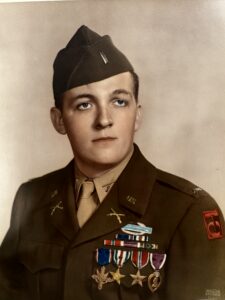
While certain names stand out within the U.S. 90th Infantry Division or its attached units—such as those of Jim Flowers, the tank crewman who was seriously wounded at Mont Castre on July 10, 1944, or Dr. William McConahey, who treated him— the name of Lieutenant Claude Ewing Lovett, who commanded a platoon in Company G of the 357th Infantry Regiment, must be mentioned, for it was he who rescued Jim Flowers, and without his intervention, Jim’s fate would certainly have been even more tragic.
But aside from this incident, Claude demonstrated bravery in combat on several occasions, earning him two Silver Stars and two Bronze Stars: in June at Normandy in the Gourbesville sector, in August during the closure of the Falaise gap, in October in the Moselle region during the battles for the capture of Metz. And in November, despite being seriously wounded, his heroic conduct in the Fort Koenigsmacker sector was recognized with the Distinguished Service Cross (the second-highest U.S. military decoration), the Purple Heart (the medal for wounded soldiers), the French Croix de guerre and other medals. A great soldier who passed away on May 8, 2012, in San Antonio, Texas.
DOWNLOAD (French version)
Clyde E. Phelps
«My three weeks in Normandy»
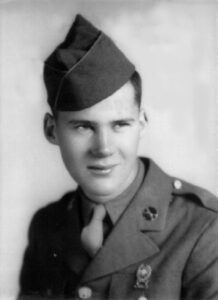
In war, survival depends in part on your skills as a soldier, but mostly on luck. Many have died simply because they were in the wrong place at the wrong time.
Many dreamed of the “$1 million wound”—one that wouldn’t kill you but, even if it didn’t allow you to be repatriated to the United States to resume a normal life after recovery, would at least let you stay away from the hell of combat for a while.
After landing on June 12 at Utah Beach as part of Company C of the 358th Regiment, 90th Infantry Division, Clyde Phelps was wounded at Saint-Jores on July 3. Evacuated and treated in England, he rejoined his unit a few months later.
He described his combat experience in these few pages titled “Three Weeks in Normandy”
James (nickname Jim) William Hoerner
«The Generalist»
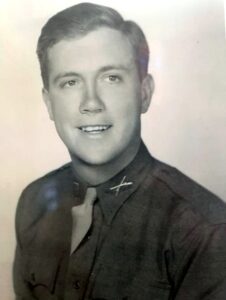
Written by his son James William (nickname Bill) Hoerner, this book compiles the memoirs of a US soldier who fought from the beaches of Normandy to Czechoslovakia and earned his stripes through bravery on the battlefields.
As quoted in the Stars and Stripes newspaper in March 1945.
“Our morale shot skyward last week with the return of our former commanding officer, Captain Hoerner.
How vividly we recall the remark of a fellow dough (soldier) as we were battling for a bridgehead across the Kyll River and the captain was out in front spearheading with his forty-five…
“Gentlemen, there goes a man!”
DOWNLOAD (French version)
Vernon N. SCHMIDT
«A hero and advocate for all others»

Vern Schmidt is one of the last (known) surviving veterans of the 90th Infantry Division. He is expected to celebrate his 100th birthday in January 2026. Arriving at the front line in late 1944, he did not fight at Normandy but in Germany, where he took part in the combat for the Siegfried Line, the crossing of the Moselle and the liberation of the Flossenbürg concentration camp. Throughout his life, he has wanted to share his experiences and pay tribute to all those who did not return.
In light of Vern’s many testimonies and his commitment to preserving the memory of the 90th Division and its men, three authors joined their forces to write a book summarizing his youth and his experience as a soldier. It is a book filled with humanity, just like Vern himself.
DOWNLOAD (French version)
Alfred B. COPT


On the battlefield, one of the most dangerous jobs was certainly that of medic or stretcher bearer, as they were unarmed and exposed to fire from both sides and had to retrieve the wounded and try to bring them to the rear. Some couldn’t handle it, and many were killed or wounded. This was the case for Albred B. Copt, a medic with the 359th.
Roy McKNIGHT


Among the thousands of anonymous soldiers who took part in World War II in the ranks of the 90th Infantry Division, many were killed or wounded without anyone knowing their fate. With the help of JQ Lynd, a former officer of the 359th and resident of Stillwater (Oklahoma) Barbara Wells, who also lives there, tried to piece together the story of her uncle Roy McKnight in Company I of the 359th.
“The Men of The Fighting 90th”
Commemorative history 1918-1991
